
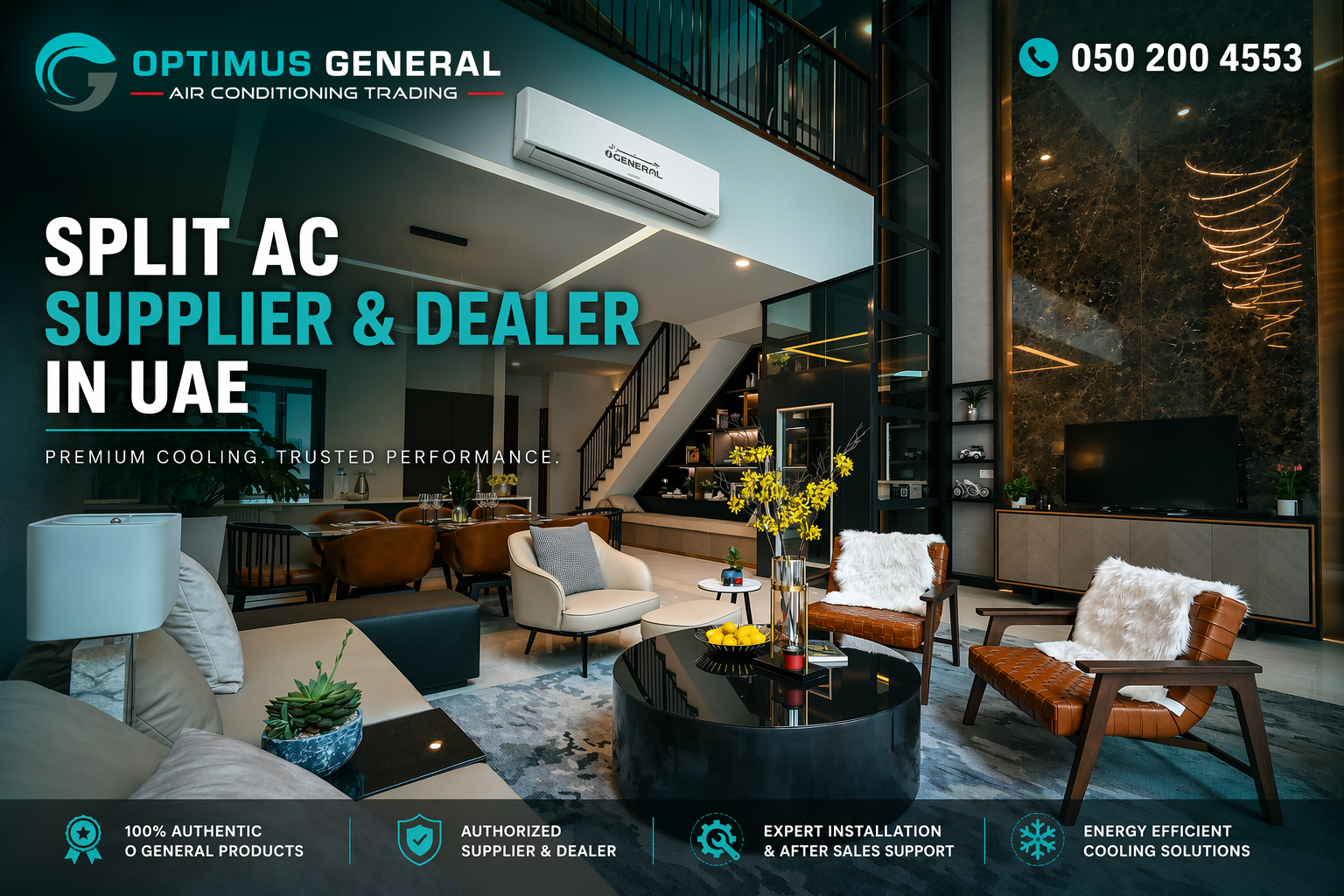
The Ultimate Guide to Choosing, Supplying, and Installing a Split AC in the UAE
Go outside in Dubai, Abu Dhabi, or Sharjah on a typical July afternoon, and the heat does not merely greet you — it assaults you. Ambient temperatures in the mid-to-high forties Celsius, combined with Gulf humidity that can push the heat index past 55 degrees, create an environment where air conditioning is not a lifestyle upgrade but a physiological necessity. In this unforgiving climate, the wall-mounted Split ac has emerged as the dominant cooling solution for millions of UAE residents — found in the vast majority of apartments from JLT to Al Nahda, in the bedrooms and living spaces of villas from Arabian Ranches to Khalifa City, and in the offices that power the nation’s economy.
Yet for all its ubiquity, the split air conditioner remains a piece of engineering that most homeowners purchase only once or twice in a lifetime, often without fully understanding what separates a system that will deliver fifteen years of reliable service from one that will begin cycling on thermal overload during its very first summer. This guide aims to close that knowledge gap. Whether you are replacing an ageing unit, fitting out a new apartment, or specifying equipment for a multi-unit residential project, the insights that follow — grounded in the specific realities of the UAE climate and market — will help you make informed decisions at every stage of the process.
Understanding the Mechanics of a Split AC System
To appreciate why a split air conditioner performs as it does, it is helpful to understand the basic physics at work. Every Split ac system — regardless of brand, capacity, or price — operates on the vapour-compression refrigeration cycle. A motor-driven compressor, housed inside the outdoor unit alongside the condenser coil, pressurises a chemical refrigerant into a high-temperature, high-pressure gas. This gas flows through the condenser coil, where a fan blows outdoor air across it, removing heat and causing the refrigerant to condense into a warm liquid. The liquid refrigerant then travels through a narrow copper pipe — the liquid line — to the indoor unit, where it passes through an expansion valve that suddenly reduces its pressure, causing it to vaporise and, in the process, to absorb a tremendous amount of heat from the indoor air passing over the evaporator coil. The now-warm refrigerant gas returns to the compressor through a second, larger-diameter copper pipe — the suction line — and the cycle repeats.
What distinguishes this split architecture from the older window-unit design is the physical separation of the noisy, heat-rejecting compressor and condenser from the quiet, cool-air-delivering evaporator. In a window unit, all of these components share a single chassis — which is why window air conditioners are invariably louder, less efficient, and restricted in where they can be installed. The split design, by placing the compressor outdoors and connecting the two halves with only a pair of copper pipes and an electrical cable passing through a small hole in the wall, delivers cooling that is quieter, more aesthetically pleasing, and capable of higher energy efficiency ratings.
Why Split ACs are the Go-To Choice for UAE Homes and Offices
Several characteristics of the split configuration make it particularly well suited to the UAE built environment. The first is installation flexibility. Unlike a ducted central system, which requires a ceiling void deep enough to accommodate insulated ductwork — a luxury not always available in apartment buildings or older villas — a Split ac can be installed in virtually any room with an external wall, with the outdoor unit placed on a designated condenser ledge, a rooftop, or even a balcony, subject to building management regulations.
The second advantage is independent zoning. With a split system in each room, occupants can set different temperatures in different spaces — a cool 22 degrees in the master bedroom for sleeping, a moderate 24 in the living room during the evening, and the unit switched off entirely in an unoccupied guest bedroom. This fine-grained control, which is far more difficult and expensive to achieve with a single central system, translates directly into lower electricity consumption and, consequently, lower DEWA or SEWA bills.
The third factor is the rapid pace at which inverter technology has transformed the energy economics of split air conditioning. An inverter-equipped split system modulates its compressor speed continuously to match the cooling demand, rather than cycling between full power and off. This eliminates the energy-wasting start-up surges that account for a significant fraction of a non-inverter unit’s electricity consumption and, equally importantly, maintains a far more stable room temperature — typically within half a degree of the thermostat set point — eliminating the uncomfortable temperature swings that non-inverter systems produce. Given that air conditioning can account for 60 to 70 percent of a UAE household’s annual electricity consumption, the financial significance of this technology is difficult to overstate.
The Undisputed Champion: Why O General Split AC Leads the UAE Market
Walk into any air conditioning showroom in Deira, ask any facility manager responsible for a portfolio of villas in Arabian Ranches, or speak with any HVAC technician who has been servicing units across the emirates for more than a decade, and one name recurs with a consistency that borders on unanimity: O General Split AC. The brand, manufactured by Japan’s Fujitsu General — which rebranded its parent entity to GENERAL Inc. in 2026 — has built a reputation in the Gulf that competing manufacturers, regardless of their marketing budgets, have struggled to match. Understanding why requires looking beyond the glossy brochures and into the engineering decisions that separate an O General unit from the alternatives on the market.
Built for the Desert: O General’s Superior Durability
The single most important specification that distinguishes an O General Split AC from the vast majority of competing products is the compressor rating. Standard air conditioners — even those from globally recognised brands — are typically equipped with T1 compressors, which are designed and validated for ambient temperatures of up to approximately 43 degrees Celsius. In a UAE summer, that limit is exceeded by 9:00 in the morning. An O General unit, by contrast, is fitted with a T3-rated tropical rotary compressor that is validated for continuous, full-capacity operation at ambient temperatures of 55 degrees Celsius — a specification that is not a marketing claim but an engineering certification that carries measurable implications for both performance and longevity.
The difference manifests most dramatically during the peak afternoon hours of July and August, when the outdoor condenser unit is sitting on a ledge or rooftop that may itself be radiating stored heat at well above the ambient air temperature. A T1 compressor under these conditions begins to struggle — its internal motor windings overheat, the thermal overload protection trips, and the unit shuts down, often for twenty to thirty minutes at a time, precisely when cooling is needed most. The T3 compressor in an O General Split AC keeps running. Over the course of a single summer, the cumulative cooling delivered by the O General unit can be significantly greater than that of a T1 competitor — not because the O General is “more powerful” in a nominal sense, but because it actually operates during the hours when the competitor has thermally shut down.
Beyond the compressor, O General units incorporate several design features that directly address the environmental challenges of the Gulf. The condenser and evaporator coils receive a proprietary Blue Fin anti-corrosion treatment — a hydrophilic coating that repels moisture, resists the adhesion of salt and dust particles, and significantly slows the electrochemical corrosion that progressively degrades untreated aluminium fins. The copper tubing used throughout the refrigeration circuit is thicker-walled and of higher purity than the industry minimum, providing greater resistance to the vibration-induced metal fatigue that can cause pinhole refrigerant leaks in cheaper units after several years of continuous operation. And the outdoor unit casing is fabricated from heavier-gauge, powder-coated steel that resists the sand abrasion and UV degradation that can leave budget units looking weathered and structurally compromised within two or three seasons.
Advanced Cooling Technologies in O General Units
Durability without performance would be an incomplete value proposition, and O General addresses both. The brand’s inverter models — which constitute the overwhelming majority of units sold in the UAE market — feature DC-driven compressors that modulate their speed across a range from approximately 25 percent to 110 percent of nominal capacity. This wide modulation range enables the unit to maintain precise temperature control while consuming significantly less electricity than a fixed-speed alternative.
The indoor unit design merits particular attention. O General’s aerodynamic fan blade geometry and carefully engineered air-path ducting enable a throw distance of up to 15 metres in the larger-capacity models — a specification that matters enormously in the open-plan living areas that characterise modern UAE apartments and villas, where shorter-throw units leave distant corners uncomfortably warm. The units also feature microprocessor-controlled louvres that can be set to sweep vertically, horizontally, or both, ensuring thorough mixing of conditioned air with room air and eliminating the cold draughts directly beneath the unit that are a common complaint with less sophisticated designs. And for bedrooms, the operating noise level on the lowest fan setting — as low as 22 decibels, which is quieter than a whisper — makes the unit essentially inaudible, a quality that anyone who has tried to sleep with a noisy air conditioner rattling on the wall will deeply appreciate.
The Step-by-Step Split AC Installation Process
A properly executed Split ac installation is every bit as important to long-term performance and reliability as the quality of the equipment itself. The installation steps that follow describe best practice as it should be performed by any competent technician working in the UAE market. Homeowners who understand these steps are better equipped to evaluate the quality of the work being performed in their own homes.
Step 1: Selecting the Perfect Location
The indoor unit should be mounted on an external wall — that is, a wall whose other side is outdoors — to minimise the length of the refrigerant pipe run between the indoor and outdoor units. The mounting height is typically between 2.1 and 2.4 metres above the finished floor, providing adequate clearance above the unit for air intake and sufficient throw distance for the cooled air to reach across the room. The unit should not be positioned directly above a bed or a sofa, where cold air blowing directly onto occupants causes discomfort, nor should it be placed on a wall that receives direct afternoon sunlight through a window, as the radiant heat will cause the unit’s thermostat to read an artificially high temperature and overcool the room.
The outdoor unit requires at least 300 millimetres of clearance on all sides — and ideally one metre on the condenser coil face — to ensure adequate airflow for heat rejection. In the UAE, where outdoor units are frequently clustered on designated ledges or rooftops, it is essential to confirm that neighbouring units will not create a microclimate of stagnant hot air around the condenser — a condition that can reduce effective cooling capacity by twenty percent or more on the hottest days.
Step 2: Drilling, Mounting, and Bracket Installation
The indoor unit’s mounting bracket must be secured to the wall using heavy-duty wall plugs and screws appropriate to the wall construction — masonry anchors for block walls, toggle bolts for plasterboard partitions. A spirit level is essential; a unit that is even slightly tilted off the horizontal will not drain condensate correctly and will eventually drip water onto the floor or furniture below. The core hole for the refrigerant pipes and drain line — typically 65 to 80 millimetres in diameter — should be drilled with a slight downward slope towards the outdoor side, ensuring that gravity assists the flow of condensate water out of the building rather than encouraging it to flow back into the indoor unit.
Step 3: Copper Piping and Insulation
The copper pipes that connect the indoor and outdoor units are the arteries of the system, and their quality and installation directly affect both performance and reliability. For an O General Split AC installation, the pipe diameter must match the manufacturer’s specification precisely — using the wrong size will alter the refrigerant velocity through the system and can degrade cooling capacity. The pipes must be insulated along their entire length using closed-cell elastomeric insulation — commonly ARMAFLEX or an equivalent brand — with a wall thickness appropriate to the pipe diameter. The insulation must be continuous, with no gaps at joints, elbows, or where the pipes pass through the wall. In the UAE’s humidity, any exposed section of cold copper pipe will immediately begin to sweat, dripping condensation that can stain walls, damage ceilings, and, over time, promote mould growth within the building structure.
Step 4: Outdoor Condenser Setup and Vacuuming
After the outdoor unit is secured in its final location — on rubber anti-vibration pads if mounted on a rooftop or ledge to minimise structure-borne noise transmission — the copper pipes are connected using flare fittings or, for larger-capacity commercial units, by brazing with a nitrogen purge to prevent oxidation inside the pipe. Before the refrigerant service valves are opened, the entire piping circuit and indoor coil must be evacuated using a two-stage rotary vane vacuum pump. This is arguably the single most critical step in the entire Split ac installation process, and it is the one most frequently rushed or skipped by technicians working against the clock. The vacuum pump must run for a minimum of 30 to 45 minutes and must achieve a vacuum of 500 microns or less, confirmed by a digital micron gauge. Moisture or air left in the system will react with the refrigerant and compressor oil over time, forming acids that attack the compressor motor windings from the inside — a slow-motion failure that may not manifest for two or three years but that is almost always terminal when it does.
Step 5: Leak Testing and Final Commissioning
After the system is charged and operational, every flare connection should be checked with an electronic refrigerant leak detector — a handheld instrument capable of sensing refrigerant concentrations as low as a few parts per million. The wall penetration should be sealed with expanding foam or silicone sealant on both the interior and exterior sides to prevent warm, humid outdoor air from entering the building cavity. The thermostat and all remote-control functions should be tested, and the temperature differential between the supply and return air — typically 12 to 16 degrees Celsius for a properly functioning system — should be measured and recorded as a baseline for future maintenance reference.
The Importance of Sourcing from a Reputable Split AC Supplier
The UAE’s air conditioning market, unfortunately, harbours a significant grey-market segment — units that are physically genuine in the sense of having been manufactured by the brand whose name they bear, but that were originally destined for a different geographic market and were subsequently diverted into the UAE through unofficial import channels. Sourcing equipment from a legitimate Split ac supplier is not merely a matter of paperwork; it is the single most important factor determining whether the unit you purchase will actually deliver the performance and longevity that its specifications promise.
The Difference Between Grey Market and Authorized Supply
A grey-market unit imported from, for example, the South Asian market will typically be fitted with a T1 compressor rated for ambient temperatures of 43 degrees Celsius at most. Its control board will be programmed with thermal protection thresholds calibrated for a cooler climate. And because it was not imported through the manufacturer’s official UAE distribution channel, the warranty — which for a premium unit like an O General Split AC includes a five-year compressor warranty that is one of the most valuable components of the purchase — will not be honoured by the manufacturer’s UAE service centre. When the compressor fails — and a T1 compressor in a UAE summer is significantly more likely to fail — the replacement cost, typically AED 2,000 to AED 3,500 including labour, falls entirely on the homeowner.
An authorised Split ac supplier, by contrast, procures every unit through the official UAE distribution network. Each unit is Gulf-spec — meaning it carries the T3 compressor, the anti-corrosion treatments, and the control logic that the local climate demands — and each one is registered for warranty at the point of sale. The price difference between an authorised unit and a grey-market unit may seem attractive in the showroom, but over the service life of the equipment, that initial saving almost invariably proves to be the most expensive discount the homeowner ever accepted.
How to Choose the Right Split AC Dealer for Your Property
Selecting a split ac dealer is a decision that should be approached with the same level of diligence that a homeowner applies to selecting a contractor for structural renovations. The dealer is not merely a retailer of equipment; they are the party responsible for specifying the correct capacity, for installing the system to the manufacturer’s standards, and for providing after-sales support throughout the warranty period and beyond.
The first credential to verify is authorisation. A competent split ac dealer should be able to produce documentation confirming their status as an authorised dealer for the brands they sell — particularly for premium brands like O General Split AC, whose manufacturer invests significant resources in training and certifying its dealer network. An authorised dealer not only has access to genuine, Gulf-spec inventory but also employs technicians who have received factory training on the specific installation and service procedures that these high-performance units require.
Second, evaluate the dealer’s approach to the pre-sale process. A dealer who provides a quotation over the phone based on nothing more than the square footage of the room, without ever visiting the property, is not performing the due diligence that a proper specification requires. A competent dealer will insist on a site visit — or, at minimum, will request detailed photographs and measurements — before recommending a specific model and capacity. They will discuss the electrical infrastructure to confirm that the existing wiring and circuit breakers can support the new equipment, and they will advise on the optimal placement of both the indoor and outdoor units based on the specific characteristics of the property.
Evaluating After-Sales Support and Maintenance Contracts
The relationship with your AC dealer should not end when the installation team packs up their tools. A dealer who is committed to long-term customer satisfaction — and who expects to be serving the same clients five or ten years from now — will offer maintenance contracts that include scheduled preventive visits, priority emergency call-out during the summer months, and discounted rates on replacement parts. Before signing a purchase agreement, ask directly about the dealer’s service response times, their spare parts inventory, and whether they maintain a record of every installation that their technicians can reference when they arrive for a service call. These are the operational details that separate a transaction-focused reseller from a genuine service partner.
Energy Efficiency and DEWA: Saving on Your Utility Bills
In the UAE, where air conditioning can account for upwards of two-thirds of a household’s total electricity consumption, the energy efficiency of a split air conditioner is not an abstract environmental metric — it is a line item on a monthly bill that, for a villa with multiple units, can exceed AED 2,000 during the summer quarter. Several straightforward practices can significantly reduce this expenditure without compromising comfort.
The first and most impactful is the choice of thermostat set point. Every degree that the thermostat is lowered below 24 degrees Celsius increases the system’s energy consumption by approximately 6 to 8 percent. Setting the thermostat to 24 degrees — rather than the 20 or 21 degrees that many households default to — can reduce monthly cooling costs by 20 to 30 percent while still maintaining a comfortable indoor environment. The “economy” or “sleep” modes available on most modern inverter split systems automate this strategy by gradually raising the set temperature during the night, when both the outdoor temperature and the body’s cooling needs naturally decrease.
Equally important is the physical integrity of the cooled space. Doors and windows must be kept closed while the air conditioner is operating — an instruction that seems obvious but that is routinely ignored in households with children or frequent visitors. Curtains or blinds should be drawn on windows that receive direct sunlight, particularly those facing south or west, to reduce the solar heat gain that the air conditioner must work to overcome. And the air filter in the indoor unit — a washable mesh panel that is accessible to the homeowner without tools — must be cleaned regularly, as a clogged filter restricts airflow, forces the compressor to work harder, and can reduce cooling capacity by 15 percent or more.
Essential Maintenance Tips for UAE Residents
Maintenance of a Split ac in the UAE is not a once-a-year afterthought; the environmental conditions demand a more engaged approach. The following practices, consistently applied, can add years to the service life of the equipment while maintaining its rated efficiency.
During the summer months, when the system may operate for eighteen to twenty hours per day, the air filters should be removed, rinsed under running water, dried completely, and reinstalled every two to three weeks. After a sandstorm — a regular occurrence in the UAE during the transitional seasons — the outdoor condenser unit should be visually inspected and, if necessary, gently hosed down to remove the layer of fine dust that will have accumulated on the condenser coil fins. Care should be taken to use a low-pressure water stream and to avoid bending the delicate aluminium fins.
The condensate drain line, which carries the water that the evaporator coil extracts from the indoor air out of the building, should be inspected periodically for blockages. In the UAE’s warm, humid conditions, algae and biofilm can grow inside the drain line, eventually forming a plug that causes water to back up and drip from the indoor unit — often staining the wall and potentially damaging furniture or flooring below. A simple test is to pour a small amount of water into the drain pan and confirm that it flows freely to the outdoor discharge point.
Annual professional servicing — ideally scheduled in early spring, before the cooling season begins — should include chemical cleaning of the evaporator coil, measurement and adjustment of the refrigerant charge, inspection and tightening of electrical connections, and verification of the system’s cooling performance against the commissioning baseline. For an O General Split AC, which is designed to deliver fifteen or more years of service with proper care, this annual investment of a few hundred dirhams is a small price to pay for the assurance that the unit will continue to perform at its rated capacity through the most demanding months of the year.
Conclusion
The split air conditioner is, for the overwhelming majority of UAE residents, the single most important appliance in the home — more critical than the oven, more relied upon than the washing machine, and more consequential for daily comfort than any piece of furniture. Choosing, supplying, and installing one is a process that rewards knowledge, diligence, and a willingness to look beyond the initial purchase price to the total cost of ownership over the system’s expected service life.
Whether you are fitting out a studio apartment in JVC, replacing ageing units in a family villa in Khalifa City, or specifying equipment for a commercial fit-out, the principles that lead to a successful outcome are consistent: insist on Gulf-spec, T3-rated equipment from a manufacturer with a demonstrable track record in the region; select a supplier and a dealer whose authorisation is verifiable and whose technical capability is evident from their approach to the pre-sale process; invest in professional installation that follows the manufacturer’s procedures and includes the critical steps of proper evacuation and commissioning; and commit to the routine maintenance that the UAE’s climate demands. An O General Split AC, installed correctly and maintained conscientiously, will reward its owner with a decade and a half or more of reliable, efficient, and unobtrusive comfort — a standard that cheaper alternatives, however attractively priced, simply cannot match.
Looking for a Reliable Split AC Supplier in the UAE?
Contact our team for expert advice, genuine Gulf-spec O General equipment, professional installation, and comprehensive after-sales support tailored to your property.
Get Your Free Consultation Today